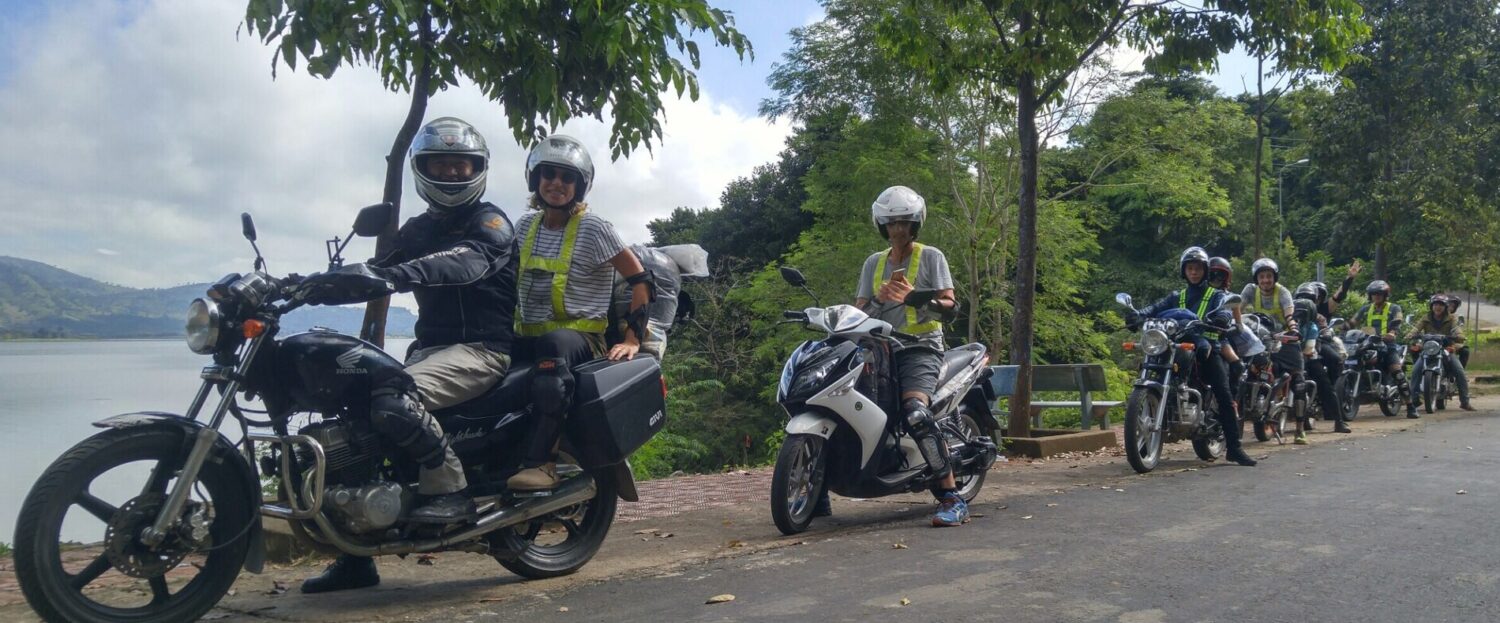

Easy Riders Taking Backpacker Tourists on Motorbike Adventures
Foreign backpackers, eager to explore Vietnam’s scenic spots and historic sites, often rent motorbikes to travel independently. To meet this growing demand, professional groups of “Easy Riders” — experienced long-distance motorbike drivers — emerged. Offering full-package services at reasonable prices with enthusiastic guidance, these Easy Riders left a lasting positive impression on visitors.
Part 1: In the Early Days, Tourists Were Terrified
In the early 1990s, many tourists visited Hoi An’s ancient town. A few places offered backpackers motorbike rentals, mostly old Minsk or DH 88 models, which were better suited for pothole-ridden, muddy roads. The two most common routes were Hoi An to Da Nang (to visit the Marble Mountains) and Hoi An to My Son Sanctuary.
Rental prices were $2 per day for the Hoi An-Da Nang round trip and $4–6 per day for the Hoi An–My Son Sanctuary route. At the time, the old bikes frequently broke down mid-journey.
An unofficial “dark alliance” among parking lot attendants, mechanics, and rogue motorbike taxis at My Son would sabotage the bikes — swapping or damaging parts. Tourists would find their rented bike unusable, forced to push it to a nearby repair shop. The mechanics would “discover” issues like broken spark plugs and offer replacements for an exorbitant $5 fee. They might even exaggerate a minor issue, urging the tourist to replace more parts “for safety.”
Tourists would return with broken parts and handwritten receipts, expecting the rental company to reimburse them. Many rental business owners in Hoi An were devastated, realizing they were being betrayed by locals preying on unsuspecting travelers.
If a tourist tried to sneak into My Son without paying the entrance fee, their parked bike would often be damaged as a form of “punishment” — sometimes even the battery would be swapped out.
Combined with treacherous road conditions — potholes in the rainy season, clouds of dust during dry spells — tourists gradually grew wary of self-driving. They realized it was often safer and less stressful to hire someone to drive them, even at a higher cost.
The Rise of the Easy Riders
Starting from 1995, as more tourists flocked to Vietnam, the number of Easy Riders in Da Nang grew rapidly. They rode old Honda 50cc bikes, Cup 70s, square-headlight Hondas, Citi models, Thai Dreams, and Minsks, ferrying both locals and foreigners alike. They offered rides from the airport or railway stations to hotels, or took guests to restaurants and nightclubs.
Mr. Lê Tiến (born 1956, residing in Chính Gián Ward) recalls,
“Back then, I rode an old Honda. If tourists wanted to go to Hoi An or even Hue, I’d take them. My prices were reasonable; no sky-high rates. Taxis were rare at that time. I learned about local customs as I traveled, eventually saving enough money to upgrade to a 100cc bike for longer trips.”
Mr. Tiến didn’t just upgrade his bike; he upgraded himself. He began planning tours, consulting with customers, and providing detailed itineraries at agreed-upon prices.
Expanding his services beyond Hoi An and Hue to the Central Highlands and northern provinces, he learned from Easy Rider groups in Da Lat, who already specialized in such tours. He even built his own website (easyriderdanang.com) and responded to clients in English. Unlike Da Lat, where Easy Riders formed organized groups, Da Nang’s Easy Riders operated independently.
Self-taught through books and field experience, Mr. Tiến steadily improved his English skills. His dedication won him many loyal customers, who spread word of his services through travel guides and personal recommendations. Some booked via his website; others sought him out upon arriving in Hoi An or Da Nang. For larger groups, he would arrange additional Easy Riders and rental bikes if needed, provided the travelers had international driving permits.
Short tours ran from Da Nang to Nha Trang or Da Lat, while longer trips stretched to Buon Ma Thuot, Saigon, the Mekong Delta, and even the mountainous Northwest.
“A good Easy Rider must be honest, enthusiastic, and capable of speaking and understanding English,” Tiến emphasized.
“You should never skip stops just to finish faster. Instead, go beyond what’s promised, show them hidden villages, local crafts, and cultural experiences. Enthusiasm brings customer loyalty — and generous tips.”
Modern Easy Riders now equip themselves with tools to handle emergencies on the road. Motorbikes today are newer, better maintained, and primarily from trusted brands like Honda and Yamaha, ensuring safer, more reliable journeys.
Part 2: Safety First, Always
One Easy Rider recounted an experience where an Australian tourist canceled a trip midway because the bike broke down. At that time, there were no Ho Chi Minh Highway routes yet, and the old bike had not been properly serviced. Instead of completing the five-day Buon Ma Thuot tour, the journey ended after only two days in Quy Nhon.
Learning from such mishaps, Easy Riders like Mr. H. from Hue sold their old bikes, investing in new 150cc models for better safety and reliability on long journeys.
Mr. Tiến himself gradually built a fleet of three brand-new, large-displacement motorbikes from Honda and Yamaha.
“When planning a five-day tour to Buon Ma Thuot with three customers, I bring all the bikes and personally guide them,” he shared.
The Da Nang Easy Rider scene once had about ten riders stationed at the train station, plus a handful more scattered around hotels, airports, and cafes along Bach Dang and Tran Phu streets, offering tours directly to tourists.
Mr. Trần Đình Nam (born 1957, from Hung Vuong Street) recalled,
“I had two vehicles — a Chinese Honda and a cyclo (pedicab). For nearby trips, I’d use the cyclo; for farther trips, the motorbike. Later, I bought a second-hand motorbike for 21 million dong and drove tourists until I retired in 2019.”
His bike, although old, rarely broke down thanks to careful maintenance and cautious driving — crucial when navigating dangerous mountain passes like Deo Lo Xo and Deo Mang Yang.
“For us, ensuring the safety of our guests is the highest priority,” he stressed.
Mr. Nam also recounted funny memories, like escorting a young Dutch woman to Buon Ma Thuot. Arriving late at night at a small hotel with only one room left, they agreed to share — two beds, no awkwardness.
Or the time he rode solo from Nha Trang back to Da Nang after dropping tourists off, setting out at 4:30 AM and arriving by 5:20 AM the next day after a grueling, sleepless journey.
Earnings and Challenges
Before 2015, a typical day’s tour cost $60 (about 1.2 million VND), with an Easy Rider pocketing around 800,000 VND after fuel and meals. In good seasons, prices rose to $70 a day. Generous tourists — especially Australians, Germans, Danes, and Swiss — often treated their Easy Riders to meals or added hefty tips for excellent service.
However, as time passed, veteran riders aged out of the profession. Some, like Mr. Quang (70 years old) and Mr. Chiến (69 years old), switched to pedicab tourism, while others retired.
Today, only a handful of Easy Riders remain active in Da Nang. Prices now range from $65 to $75 per day, with entrance fees and accommodations handled by the Easy Rider, and meals split 50-50 with the tourist. After expenses, an Easy Rider might still earn about 1–1.3 million VND daily.
Meanwhile, younger drivers — often college graduates fluent in English and French — have entered the scene, offering lower prices and disrupting the traditional Easy Rider business model. Travel companies also offer organized motorbike tours, further squeezing independent riders.
Ngô Xuân Nhật (born 1992), with ten years’ experience riding the Hue-Da Nang-Saigon route, said:
“In Hue today, there are about 200 Easy Riders. Some are 73 years old and still going strong, while others retire as early as 60.”
Long-distance motorbike touring demands health, alertness, and quick reflexes to prevent accidents. As the years wear on, many old Easy Riders find themselves reluctantly stepping away from the road they love.
Copyright © by Lê Kung Diễm
Contact: Lê Kim Dũng, H 09/11/K16, Lý Thái Tổ Street, Thạc Gián Ward, Đà Nẵng City, Vietnam
Email: [email protected]
Phone: +84 91 345 9781
Bank Account: 2015 2061 08425 (Vietnam Bank for Agriculture and Rural Development)